The process of updating the Pinal model geology was begun in 2007, and had not been addressed since Modeling Report No. 2 (Corkhill and Hill, 1990). The purpose of this provisional report is to document the data collection activities and findings of the hydrogeologic framework of the study area. This report will be finalized after the Pinal Active Management Area (AMA) Regional Groundwater Flow Model report which documents the update and recalibration of the groundwater flow model in Pinal County have been completed.
Materials that meet the criteria of Freedom of Information Act exemptions are not posted on this website. Culturally sensitive materials not posted here fall under this criteria.
Proposal to list the monarch butterfly (Danaus plexippus), the iconic orange and black butterfly, as a threatened species and designate critical habitat under the Endangered Species Act of 1973, as amended (Act).
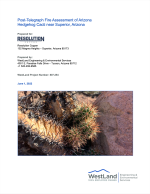
Assessment of the impacts of the Telegraph Fire on Arizona hedgehog cactus (AHC; Echinocereus triglochidiatus var. arizonicus) located east of the town of Superior in Pinal County, Arizona.
Materials that meet the criteria of Freedom of Information Act exemptions are not posted on this website. Culturally sensitive materials not posted here fall under this criteria.
Resolution Copper Company commissioned Golder and Associates to establish a program for the collection of baseline surface water data near the future RCC mine and associated facilities. The intended uses of the data are primarily to support and EIS, develop a sound conceptual site model as a basis for predicting future impacts, and document current conditions as a baseline for judging future impacts.
This report summarizes the meteorological, nitrogen dioxide (NO2), sulfur dioxide (SO2), ozone (O3), and particulate matter (PM) data collected at the Resolution Copper Project near Superior, Arizona for the third quarter, July 1-September 30, 2013.
This tech memo has been prepared to summarize results of the Phase II field investigations of the Near West site, conducted in support of RCM's ongoing prefeasibility studies for storage of RCM mine tailings. The purpose of Phase II investigations was to conduct electrical resistivity surveys to assess the potential occurrence of shallow groundwater at the Near West site.
Three motion-sensitive cameras besides springs within a study area along Devils Canyon. Cameras captured numerous identifiable images of animals representing both mammals and bird species.