Breadcrumb

  1. Home
  2. Documents

Documents

Web-based mapping tool. A new tool that provides hunters, anglers, and other outdoor recreationists with access information to and through private lands.

This dataset contains Rangeland Management Units for each national forest in Arizona. Each National Forest grazing allotment, or Rangeland Management Unit (RMU), is a designated area of land available for livestock grazing, managed by the Forest Service, and may be subdivided into pastures necessary for grazing management.

At the request of Mr. Greg Hiner of The Trust for Public Land, Golder Associates Inc. (Golder) performed a Phase I Environmental Site Assessment (ESA) of a forested property comprising all of Township 14 North, Range 12 East, Section 9, Gila and Salt River Baseline and Meridian in Coconino County, Arizona (herein referred to as the subject property or Site).

Every census must adapt to the decade in which it is administered. New technologies emerge and change the way the U.S. Census Bureau collects and processes data. More importantly, changing lifestyles and emerging sensitivities among the people of the United States necessitate modifications to the questions that are asked. One of the most important changes for Census 2000 was the revision of the questions on race and Hispanic origin to better reflect the country’s growing diversity.

COVER ONLY

*Note: Documents with sensitive species information may not be available for download.

This technical memorandum was prepared to summarize results of drilling, construction, and testing at hydrologic test well HRES-13. The well was installed to characterize hydrogeologic conditions and provide a monitoring location in the western part of the Apache Leap Tuff (ALT) aquifer. Monitoring data obtained from HRES-13 have been incorporated into the RCM hydrologic monitoring program.

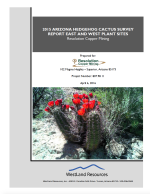
Arizona hedgehog cactus survey was conducted along areas proposed for pre-feasibility activities.

A series of flotation tests had been conducted at DML on the three individual composites that comprise MC-1. The initial scope of that test work was to evaluate if:

In this chapter we survey and synthesize available information on the major physical-chemical properties of hydrous ferric oxide (HFO). After examining the structure and composition of HFO, we present published data for surface area, site densities, and surface acid-base properties. Our main purpose is to obtain best estimates for the surface properties of HFO and provide a sense for the consistency of the corresponding experimental data.

In previous ground-motion models, the range of applicability of the empirical ground-motion models was based on the range covered by the available empirical data set; however, in hazard studies, the ground motion must be computed for all relevant earthquakes, so the limits on the range of applicability were often ignored. To address this issue, the Next Generation Attenuation (NGA) project required the developers of the models to extrapolate their models such that they are applicable to all crustal earthquakes relevant for seismic hazard analyses in California.